Romans 13:1 ¨Obey the government, for God is the one who has put it there. There is no government anywhere that God has not placed in power. 2 So those who refuse to obey the laws of the land are refusing to obey God, and punishment will follow. 3 For the policeman does not frighten people who are doing right; but those doing evil will always fear him. So if you don’t want to be afraid, keep the laws and you will get along well. 4 The policeman is sent by God to help you. But if you are doing something wrong, of course you should be afraid, for he will have you punished. He is sent by God for that very purpose. 5 Obey the laws, then, for two reasons: first, to keep from being punished, and second, just because you know you should.¨
2 Timothy 3:16 ¨All Scripture is breathed out by God and profitable for teaching, for reproof, for correction, and for training in righteousness, 17 that the man of God may be complete, equipped for every good work.¨
If we take both of these scriptures as completely true and beyond question, we lose the ability to fight Hitler or dislike the President. Is that where we are meant to be? Martin Luther King Jr. would not say so, neither would Augustine. Martin Luther King, in his famous "Letter from the Birmingham Jail," called on all Americans to actively but peacefully oppose laws that were morally wrong. King wrote:
"There are just laws and there are unjust laws. I would agree with St. Augustine that an unjust law is no law at all... One who breaks an unjust law must do it openly, lovingly...I submit that an individual who breaks a law that conscience tells him is unjust, and willingly accepts the penalty by staying in jail to arouse the conscience of the community over its injustice, is in reality expressing the very highest respect for law."
We have to think. We can't just accept what we are told on the radio, church or by authority figures. So unless we believe in the depths of our souls that Hitler was placed in power by God and disobedience meant punishment, we have to be willing, as Christians, to intelligently question scripture.
Author Darcy Leech reflects on losing her mother and brother to the same disease, myotonic dystrophy, and raising a healthy son in a modern world as a high school English teacher married to a history teacher.
Wednesday, June 11, 2014
Saturday, April 5, 2014
The Strongest Woman Died of Weakening Muscles - Eulogy for my Mother
Life is beautiful and grand, and the little ironies have a way of teaching us the most. My mother is the strongest woman I will ever know. The strongest woman I will ever know died because her muscles became too weak. That irony tells me true strength is not physical.
My mother’s faith, out of all she’s given me, is the most wonderful gift a mother could give a child. My mother’s faith was the strongest part of the strongest woman I know.
Shortly after my mother passed, we watched home videos as a family. In one, we are at the Great Salt Lake in Utah. The white sand stretches to the shore of an expansive still lake, and my mother sits with her chin resting on her hand, watching my father hold Dustin and me swimming in the distance. Later, I play king of the hill with my mother as she stands atop a rock and successfully keeps me from getting on with her or pulling her off. In 1998, at age 38, my mother had a very capable body.
If you met my mother since 2002, you do not know her full story. My brother Dustin passed away this day, September 23rd, nine years ago. A mother’s greatest legacy is always in her children. If my mother’s greatest gift to me was her faith, my mother’s greatest gift to the rest of the world was bringing Dustin into it and loving him so much the rest of the world couldn’t help but love him too.
My mother and brother died from the same disease – myotonic dystrophy. My brother was born with severe congenital myotonic dystrophy. His case was so rare that university hospitals paid for sleep studies. Myotonic dystrophy affects about 1 in 8000 people. In my immediate family, it affected 2 of 4. Myotonic dystrophy took my brother’s life, and my mother’s life. The irony is that by having this disease, my mother and my brother taught me such lessons of strength and faith as I will find in no other book save the Bible.
I consider my brother the most innocent individual I have met. I believe he saw angels and giggled as they danced. People loved Dustin on sight; all he had to do was drool and grunt and they were hooked. With Dustin I saw God in normal people and troubling situations. My mother gave me the ‘good’ X chromosone, and I will hopefully live a long healthy life. From my mother my brother inherited myotonic dystrophy, which could be seen as the ‘bad’ X. However, Dustin’s life was beautiful, emphatic, and life changing for so many that met him no more than a day. My mother brought Dustin into the world, and Dustin brought joy, love, and a visible sign of God’s mark upon creation.
My mother was not affected from birth by myotonic dystrophy; instead from age 30 on, my mother’s body gradually weakened. At 18 my mother competed in beauty pageants, by 40 she had one leg that swelled and affected her confidence, by age 50, in New Mexico a few days before her final trip to the ER, the disease had caused her facial muscles to relax so that her jaw was slack and her eyes were drooping. She didn't have the muscle strength to smile for family pictures.
Looking from the outside without knowledge of her history, my mother might appear lazy or weak-willed. Having been raised by her, watching her care for and bury Dustin and still give her everything to me, and witnessing her faith in the hospital, I know my mother is the strongest woman I will ever meet. The irony is we didn’t really know how much the disease was affecting her until the ICU at Hays. In the hospital, my mother’s condition reminded me to give everyone love and support; you never know what they struggle against that you cannot see.
In the hospital we struggled with questions about life support and resuscitation. It is a complicated emotion to see your mother cry and try to push away the needle that will stick when she has been stuck 4 times a day for 6 weeks. It is unfortunate my mother died in a hospital, unfortunate her disease caused her lungs to fail - It is beautiful that I got to spend time with my mother in her final days. In her final week, I realized the great faith of the strongest woman I will ever know.
In the hospital my mother was afflicted with pain, afraid of the unknown, affected by memory loss, bruised on her arms from needle pricks, and lonely when we couldn’t be there. Such a situation may seem tragic; however, my mother made it gorgeous. Jo Lyn told me she loved me every time she saw me, kissed me on the cheek with a tenderness I will always feel in my heart, summoned all her strength to wrap her arms around me in a loving embrace. I’ve always loved and respected my mother, but in the hospital my mother became my hero. My father was constantly at mom’s side. Seeing my father care for my mother, he too is my hero. My parents had a wonderful marriage, and witnessing my mother wrap her arms around my father from her hospital chair and kiss his lips with the tender gentleness of eternal love made me pray that Daniel and I could have a love as strong as my parents when we are 50.
Knowing her condition, knowing she wasn’t getting stronger but instead weaker, my mother consciously chose to face death with her faith and her family. My mother prayed constantly. My mother would ask me to pray. My mother trusted God. My mother trusted God enough to live with the pain, to try to become stronger, and in the end, to wait for her family and show them with firm resolution that God was present in her life and that she was willing to greet Jesus in heaven. My mother requested for my grandmother to sing “I’ll fly away”, telling us that she knew, as the song goes “Just a few more weary days and then, I'll fly away, To a land where joy will never end, I'll fly away.” My mother let us know she was at peace, and would find even greater joy.
The night before the ventilator would be turned off , I feared the pain for my mother, I feared my own weakness in decision, I feared losing the mother I had had all of my life, the best mother, the dearest person and a close friend.
My mother reassured me.
A day before she told me that she had good dreams; she was at peace. I asked her what she dreamed of, and she wrote she ‘dreams of Dustin.’ I asked my mother what Dustin was doing, and she used her strength to make physical imitations of running, jumping, and then with a closed fist, lifted her knuckle up and down repeatedly in rows. I asked her what that motion meant; she said something I couldn’t understand, unable to read the lips of someone whose muscles weaken every day. I handed her paper and a pen, and with scratchy handwriting she wrote “waters the garden”. I read the words back to her and asked: “so Dustin waters the gardens in heaven, huh?” She nodded yes and smiled. The irony is that in my brother being in heaven, and my mother dreaming of him before she joins him, I was reminded of the great solace of life: in heaven there is no pain, no disabilities, we all have value, and in heaven we are wrapped in the warm embrace of God's love.
When the morning came, my heart sat in general numbness as my mother slept. My father and I held hands, watching her rest peacefully. She woke up about an hour before the ventilator would be removed. Dad and I held her hand, kissed her, hugged her, and she smiled. We went through a stack of pictures, reread the notes on the backs, relived memories, thanked her for the good times, and shared a love that will never die.
The nurse came in to ask my mother if she was ready for the ventilator to be turned off. She mouthed yes. The nurse asked if she would like the trach completely removed or capped; my mother responded removed. The machine was turned off, the trach removed, and my mother pulled the strap off her neck. She smiled at us, her burden gone, and drifted gently off to sleep. I watched her breath become more and more shallow, counted the seconds in-between. Daniel held Eli, and Eli started to cry in hunger. I let go of my mother’s hand, held my baby, and nursed my son. I was feeding Eli as my mother stopped breathing. I was holding my son as the nurses checked for a pulse no longer there. Another of life’s ironies, at the moment my mother was dying, my son was growing from my ability to give him a gift as his mother.
My mother had planned to watch Eli in his first year while I worked. She was going to live with us, care for Eli every weekday. My mother and I both looked toward that time with great joy. My mother was going to be able to teach me to be as good of a mother as she was, help me learn what it means to care for your own child. My mother didn’t get that chance.
However, in showing me her faith in her final days, by trusting God resolutely, by wanting to see her own mother so much, by dreaming of her own son in heaven, by holding my hand and telling me to take care of myself and love Eli, my mother showed me the full truth of what a great mother does for her children. My mother is not only the strongest person I will ever meet, she is the best mother I could have. If there is one thing I ask God to give me, it would be the strength to love my child - like my mother does.
song that played next:
http://www.youtube.com/watch?v=TUKmuXXkhxE&feature=fvst


My mother’s faith, out of all she’s given me, is the most wonderful gift a mother could give a child. My mother’s faith was the strongest part of the strongest woman I know.
Shortly after my mother passed, we watched home videos as a family. In one, we are at the Great Salt Lake in Utah. The white sand stretches to the shore of an expansive still lake, and my mother sits with her chin resting on her hand, watching my father hold Dustin and me swimming in the distance. Later, I play king of the hill with my mother as she stands atop a rock and successfully keeps me from getting on with her or pulling her off. In 1998, at age 38, my mother had a very capable body.
If you met my mother since 2002, you do not know her full story. My brother Dustin passed away this day, September 23rd, nine years ago. A mother’s greatest legacy is always in her children. If my mother’s greatest gift to me was her faith, my mother’s greatest gift to the rest of the world was bringing Dustin into it and loving him so much the rest of the world couldn’t help but love him too.
My mother and brother died from the same disease – myotonic dystrophy. My brother was born with severe congenital myotonic dystrophy. His case was so rare that university hospitals paid for sleep studies. Myotonic dystrophy affects about 1 in 8000 people. In my immediate family, it affected 2 of 4. Myotonic dystrophy took my brother’s life, and my mother’s life. The irony is that by having this disease, my mother and my brother taught me such lessons of strength and faith as I will find in no other book save the Bible.
I consider my brother the most innocent individual I have met. I believe he saw angels and giggled as they danced. People loved Dustin on sight; all he had to do was drool and grunt and they were hooked. With Dustin I saw God in normal people and troubling situations. My mother gave me the ‘good’ X chromosone, and I will hopefully live a long healthy life. From my mother my brother inherited myotonic dystrophy, which could be seen as the ‘bad’ X. However, Dustin’s life was beautiful, emphatic, and life changing for so many that met him no more than a day. My mother brought Dustin into the world, and Dustin brought joy, love, and a visible sign of God’s mark upon creation.
My mother was not affected from birth by myotonic dystrophy; instead from age 30 on, my mother’s body gradually weakened. At 18 my mother competed in beauty pageants, by 40 she had one leg that swelled and affected her confidence, by age 50, in New Mexico a few days before her final trip to the ER, the disease had caused her facial muscles to relax so that her jaw was slack and her eyes were drooping. She didn't have the muscle strength to smile for family pictures.
Looking from the outside without knowledge of her history, my mother might appear lazy or weak-willed. Having been raised by her, watching her care for and bury Dustin and still give her everything to me, and witnessing her faith in the hospital, I know my mother is the strongest woman I will ever meet. The irony is we didn’t really know how much the disease was affecting her until the ICU at Hays. In the hospital, my mother’s condition reminded me to give everyone love and support; you never know what they struggle against that you cannot see.
In the hospital we struggled with questions about life support and resuscitation. It is a complicated emotion to see your mother cry and try to push away the needle that will stick when she has been stuck 4 times a day for 6 weeks. It is unfortunate my mother died in a hospital, unfortunate her disease caused her lungs to fail - It is beautiful that I got to spend time with my mother in her final days. In her final week, I realized the great faith of the strongest woman I will ever know.
In the hospital my mother was afflicted with pain, afraid of the unknown, affected by memory loss, bruised on her arms from needle pricks, and lonely when we couldn’t be there. Such a situation may seem tragic; however, my mother made it gorgeous. Jo Lyn told me she loved me every time she saw me, kissed me on the cheek with a tenderness I will always feel in my heart, summoned all her strength to wrap her arms around me in a loving embrace. I’ve always loved and respected my mother, but in the hospital my mother became my hero. My father was constantly at mom’s side. Seeing my father care for my mother, he too is my hero. My parents had a wonderful marriage, and witnessing my mother wrap her arms around my father from her hospital chair and kiss his lips with the tender gentleness of eternal love made me pray that Daniel and I could have a love as strong as my parents when we are 50.
Knowing her condition, knowing she wasn’t getting stronger but instead weaker, my mother consciously chose to face death with her faith and her family. My mother prayed constantly. My mother would ask me to pray. My mother trusted God. My mother trusted God enough to live with the pain, to try to become stronger, and in the end, to wait for her family and show them with firm resolution that God was present in her life and that she was willing to greet Jesus in heaven. My mother requested for my grandmother to sing “I’ll fly away”, telling us that she knew, as the song goes “Just a few more weary days and then, I'll fly away, To a land where joy will never end, I'll fly away.” My mother let us know she was at peace, and would find even greater joy.
The night before the ventilator would be turned off , I feared the pain for my mother, I feared my own weakness in decision, I feared losing the mother I had had all of my life, the best mother, the dearest person and a close friend.
My mother reassured me.
A day before she told me that she had good dreams; she was at peace. I asked her what she dreamed of, and she wrote she ‘dreams of Dustin.’ I asked my mother what Dustin was doing, and she used her strength to make physical imitations of running, jumping, and then with a closed fist, lifted her knuckle up and down repeatedly in rows. I asked her what that motion meant; she said something I couldn’t understand, unable to read the lips of someone whose muscles weaken every day. I handed her paper and a pen, and with scratchy handwriting she wrote “waters the garden”. I read the words back to her and asked: “so Dustin waters the gardens in heaven, huh?” She nodded yes and smiled. The irony is that in my brother being in heaven, and my mother dreaming of him before she joins him, I was reminded of the great solace of life: in heaven there is no pain, no disabilities, we all have value, and in heaven we are wrapped in the warm embrace of God's love.
When the morning came, my heart sat in general numbness as my mother slept. My father and I held hands, watching her rest peacefully. She woke up about an hour before the ventilator would be removed. Dad and I held her hand, kissed her, hugged her, and she smiled. We went through a stack of pictures, reread the notes on the backs, relived memories, thanked her for the good times, and shared a love that will never die.
The nurse came in to ask my mother if she was ready for the ventilator to be turned off. She mouthed yes. The nurse asked if she would like the trach completely removed or capped; my mother responded removed. The machine was turned off, the trach removed, and my mother pulled the strap off her neck. She smiled at us, her burden gone, and drifted gently off to sleep. I watched her breath become more and more shallow, counted the seconds in-between. Daniel held Eli, and Eli started to cry in hunger. I let go of my mother’s hand, held my baby, and nursed my son. I was feeding Eli as my mother stopped breathing. I was holding my son as the nurses checked for a pulse no longer there. Another of life’s ironies, at the moment my mother was dying, my son was growing from my ability to give him a gift as his mother.
My mother had planned to watch Eli in his first year while I worked. She was going to live with us, care for Eli every weekday. My mother and I both looked toward that time with great joy. My mother was going to be able to teach me to be as good of a mother as she was, help me learn what it means to care for your own child. My mother didn’t get that chance.
However, in showing me her faith in her final days, by trusting God resolutely, by wanting to see her own mother so much, by dreaming of her own son in heaven, by holding my hand and telling me to take care of myself and love Eli, my mother showed me the full truth of what a great mother does for her children. My mother is not only the strongest person I will ever meet, she is the best mother I could have. If there is one thing I ask God to give me, it would be the strength to love my child - like my mother does.
song that played next:
http://www.youtube.com/watch?v=TUKmuXXkhxE&feature=fvst

The strongest woman I will ever know...

Family photo in 1998 Dustin passed away in 2002; mother passed away Sept 20 2011.

Mom in 1982


My parents' love has blessed my life in many ways, but seeing them care and comfort each other so well in this time warms my heart. My parents are good role models of love. :D

getting a hug from my mommy


Sunday, January 5, 2014
Letter to my Intensive Reading Students for Monday
I teach Intensive Reading class where students who read below grade level work to raise their reading ability to grade level or better. Here is the letter we will do as a fluency reading on Monday when we return for second semester:
Dear Students,
I am
glad to be back for another semester. We
made great progress by raising lexile scores, reading hundreds of pages per
person, developing better fluency, and passing so many classes. I am proud of you!
I look
forward to building our skills and reading interesting texts to better our
knowledge. I enjoy teaching and watching
the young men and women I teach grow to be well informed capable adults. I believe each one of you will grow to be a successful
adult and be able to read complex texts and make smart decisions on your
own.
We will
continue to find success and grow in ability to identify the meaning and
purpose of written words. Analyzing author’s
purpose is particularly important.
Knowing what an author is trying to do is important because some author’s
will purposefully try to mislead or convince the reader of something not
necessarily true. It is important to be
a careful and aware reading when it comes to money. To be a responsible and self-sufficient
adult, one needs to understand author’s purpose to avoid being cheated or
mislead.
Reading
well is a vital skill thriving in modern America. Those who strive to read well can make better
decisions, spend money wisely, and communicate effectively through computers
and the internet. Reading opens realms
of imagination, relaxation, and higher learning. Investing in reading well this semester will
show rewards not only in high school, but in post-secondary learning, work
force advancement, or personal enjoyment.
Reading matters, and together we can read better.
I look
forward to seeing the growth we achieve this semester. I am personally invested in helping you be a
better reader and opening opportunities for the future. How much can you do this semester to improve
your reading ability?
(It's just under 300 words - so that is a one page fluency reading :) )
Sunday, December 15, 2013
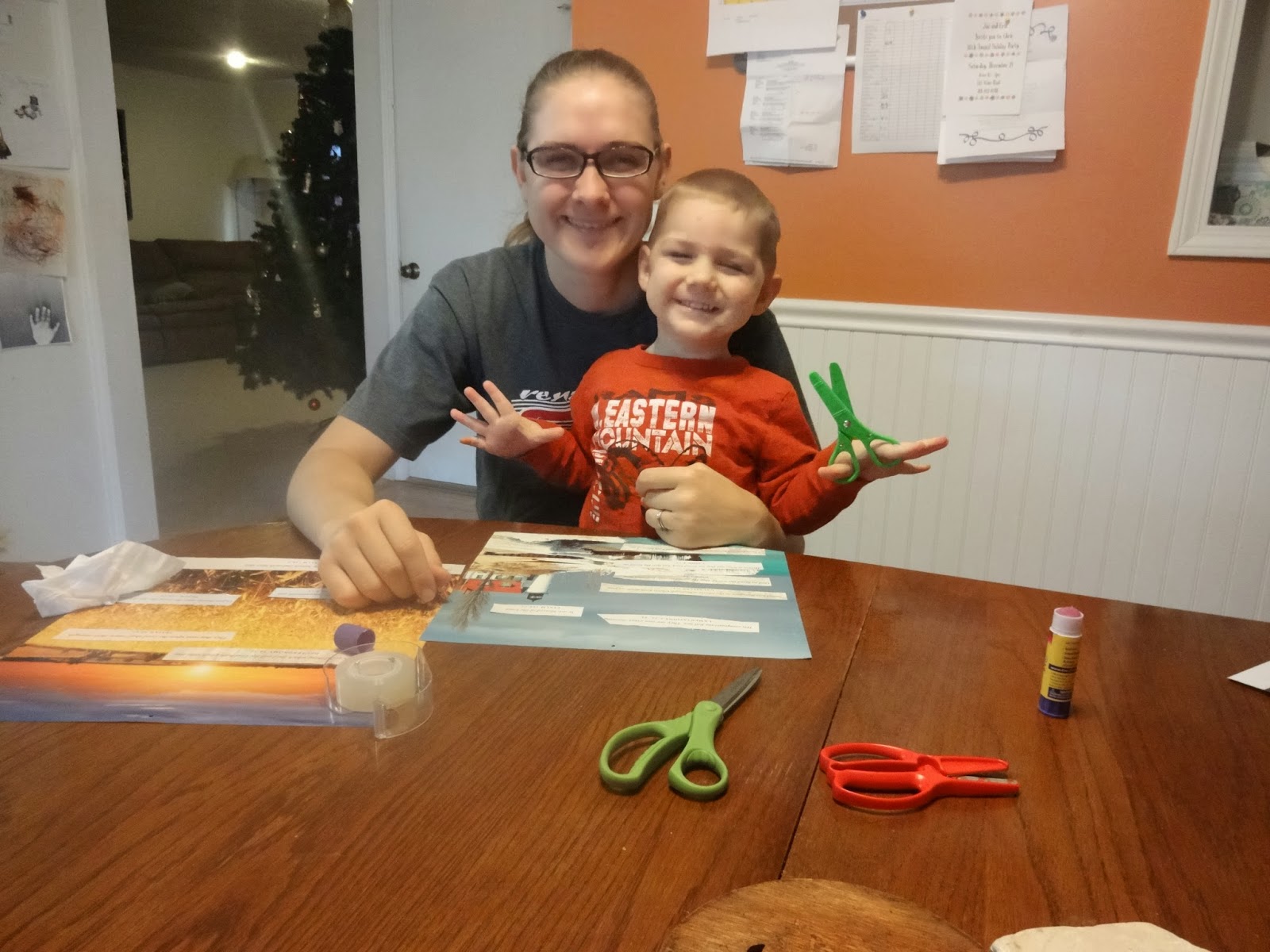
End of Year Toddler Craft - Calendar Cut up Artwork

Today my almost 2 and a half year old son, Eli, and I sat
down for craft time with our old 2013 calendar, two pair of scissors, and a
glue stick. This would probably work
with any calendar, but we had a calendar with Bible verses for each month and
in our Christian house this was a good activity to teach my son more about the
season we will soon be celebrating – Christmas.
First, I let him flip through the calendar and we picked his
two favorite pictures: a light house on a ice covered cape, and a wheat field reminiscent
of Kansas. I cut those two images out as
our backgrounds. Then, while he
practiced cutting on a page that would become scrap paper, I began cutting the
Bible verses from each month and reading the verses aloud to Eli.
Once all the verses were cut, I would hold the verse, he
would hold the open glue stick, and I would help him glue the back of the
verse, ask him where he wanted it to go, he would point to a spot on one of the
backgrounds, I’d place it there, and he’d pat it down. After each verse was glued in place, I’d read
it. Then we’d repeat. He really enjoyed the making the project and
using the glue sticks. If he were older,
he probably could have done all the cutting himself, but as it was it was fun
and not frustrating for my son’s budding skills and gave us a chance to talk
about Jesus preparing for the upcoming holiday season.
Once we had our two backgrounds near complete, we had dad
take pictures so Eli would feel special and appreciated in his artistic
efforts, then we picked a place on his craft wall, and hung the pictures
together. To top off the craft session,
I grabbed a puppet who commenced to ask Eli questions about his craft and let
Eli ‘show off’ his artwork to ‘someone’ besides me. Overall a pretty easy craft for a parent and
young child that had good results, made use of an old calendar, and in this
case helped our family focus a little more on the meaning of the season with
Christmas – Jesus Christ.
Friday, December 13, 2013
The Problem of Physical Medical Records and Silent Diseases (revision of Ch 7 excerpt)
Knowing of Dustin’s disease and
shortened life expectancy since the age of three, I grew up well informed about
myotonic dystrophy. Or rather, I thought
I did. My father told me soon after Dustin was born that my brother was likely
to die before I did. As a three year
old, I doubt I understood much of what that really meant, but Dustin’s
condition and outlook were never a secret from me. I knew my brother needed open heart surgery
soon after birth, required help breathing in the first three months of his
life, had a feeding tube for the first six years and wore oxygen in his nose to
bed until he was 11 or so. I knew
myotonic dystrophy gave my brother weaker muscles, that he had inherited the
gene from my mother and that I was likely unaffected based on my good health
and academic success. It seemed I knew
quite a lot about muscles and genetics for being so young.
Growing up I grappled with the
proposition that my brother was likely never to walk. I went along to multiple doctor visits to
evaluate Dustin’s ‘club foot’, a condition I didn’t know the technical term
for, ‘talipes’, until 15 years later. I
knew my brother’s feet curved in a way that caused his toes to curl in and
under towards the arch of his foot. I
remember reading in the hospital waiting room as Dustin underwent surgery for a
third time to tighten his Achilles tendon to correct the bend of his feet and
enable him to walk. The doctor let me
feel the mold for Dustin’s leg braces before it were to be cast. In caring for
a severely handicapped child, it is important all capable willing members of
the family are knowledgeable in how to assist in the daily exercises to build
strength and gain skill, and that the family members feel excited and important
in assisting the handicapped child. In
subsequent visits, I was taught how to put the braces on Dustin, tied his shoes
over them, lead Dustin to the rail, and helped him take steps.
In one visit where the doctor wanted to
train the family to teach Dustin to walk, I wondered if my brother would let me
help, or if I would be any good in helping my brother to do something he had
never before been able to do. I
approached the room my brother was in tentatively, wanting so much to be a part
of helping my brother to walk, to be more like me, to overcome the odds and
nervous that Dustin might not let me help.
Luckily, he was in a good mood and receptive; when I walked into the
room and said his name with open arms to go hug him, his lips raised in a
smile, he brought his hand to his mouth, shot his legs out in excitement, and gurgled
in delight, welcoming me in the activity as if what the doctor had done was a
game.
I smiled at my brother, and playfully
called him by his nickname: “Hey udey-dude.”
Dustin seemed relaxed, and apparently the doctor approved as he placed
the brace in my hand. In my left palm I
held the smooth back of the brace which was molded to my brother’s leg, curved
and smooth. In my right hand I held the
flat based that would go under his foot.
The inside was molded to his foot, but the outside was formed to create
a solid base and felt more like an odd type of dress shoe. I rubbed my thumb on the inside where the
ball of my brother’s foot would sit. It
had a crisscrossed pattern across it to create friction and prevent
slippage. The brace was impressively
light and durable. I raised the brace to
my brother’s foot, slid his heel deep into the corner of the brace, moved my
left hand to cover the front of his leg and hold the grace, then took the
bottom Velcro in my right hand, pulled it over his foot, and secured the Velcro
tightly onto the other side of the brace.
I pushed his calf against the back of the brace securely and began to
take the bottom strap diagonally to the top Velcro catch, then crisscrossed the
top strap to the bottom Velcro. Dustin’s
foot was secure and he didn’t seem to mind the brace. I eagerly took his
already loosened shoes, maneuvered them over the brace and his foot, and
carefully tied his shoe over the brace. I
had gotten to practice the steps of strapping my brother into the brace and
tying his shoes over them before; however, today was going to add another step
I had not yet been allowed to do.
I
felt my chest leap with excitement as we lead Dustin to the rails. I held my brother’s hand, smiled at him and
placed his hand on the rail. He let out
a breath which hissed in a tone between excitement and caution. His hand said he trusted me, but his eyes
widened as he looked down at his feet and realized how high up his head was
compared to when he sat on the floor.
His scrawny legs were weak and wobbly, awkwardly small amid his large
knobby knees and bulky braces. The physical
therapist in the room reached down to move Dustin’s leg, one at a time, and my
brother stepped about three feet with the therapist moving his legs, me holding
just above his hips, and the doctor watching.
It felt like a success and for a while my young heart thought anything was
possible.
As a child, I was told about myotonic dystrophy
in cautionary, optimistic tones. The
adults around Dustin wanted me to care about my brother and be hopeful, but
they didn’t want me to think the answer to Dustin’s troubles were like
something that Santa was going to deliver after flying to my roof and climbing
through my chimney. When the doctor
wanted to train me to help Dustin walk, I was partially seen as a resource who
could assist in getting Dustin daily practice and repetitions. I was an eager young girl who believed in her
brother getting stronger without the limits of logic or the experience of
seeing someone get weaker instead of stronger.
I was youthfully and eternally convinced that my brother could learn to
walk. I think the doctor was partially
willing to involve me in the process so that I didn’t hurt my brother by trying
on my own without training.
As Dustin passed infancy and grew from a
toddler to a young child, his body seemed to become healthier and more
durable. His vitality and capabilities
increased with time. By the time of the
attempts to get Dustin to walk, he no longer needed his feeding tube, but could
feed himself with a spoon or fork. He no
longer needed oxygen and could communicate with varying pitches and tones in
most vowel sounds and a large range of consonants. Dustin was able to wheel himself to the balloons
at Wal-Mart, interact during recess at school, and scoot anywhere in the house
using his arms to push his bottom forward. While his obstacles at birth were
severe and life threatening, his prognosis seemed to be ever improving as he
outlasted life expectancy predictions and progressed in ways doctors said he
never would. Learning to walk seemed
like the next logical step. All the news
that reached my ears seemed to be good news and besides when he was sick, I had
only seen my brother get stronger over the years; even when Dustin was sick, I’d
be told with the right medical attention, he would be ok. I began to think that
with enough prayer and willpower, anything could happen if God were
willing.
I wished fervently for my brother to be
able to walk. I prayed for him nightly,
threw quarters in wishing wells, and was diligent in helping him wear his
braces and insisted on constant walking practices with him after school. I would stretch
my brother’s legs, rotate his ankles, do resistance exercises and help him
practice standing. However, it didn’t
take long before Dustin didn’t enjoy wearing the braces much, and
sometimes I would want to practice longer than he was comfortable. My 10 year old brain was convinced my brother
was gaining strength and would one day be able to walk because he had broken so
many limiting expectations in the past.
At times I would hold Dustin’s hand next
to a rail, at others I would have him hold onto my waist and we would walk
together. After a while, our public
school built an apparatus which was basically a long flat board with side
supports and hand rail on either side so Dustin had a platform to walk
across. He had a stander at school, and
various walking assistance equipment. At
home, when Dustin would seem as if he were done walking, often I would have him
stand leaning on the couch. My fifth
grade logic thought this good practice, that standing after he had worked the
muscles would build good endurance and lead to muscle strength. I wanted my
will power and effort to be able to change the predictions on the limits of my
brother’s potential.
Dustin would lean with his forarms
resting on the edge of the couch. He was
tall enough that he would bend at the hip, his waist jutting out awkwardly from
side to side as he rotated his balance.
His knobby knees would dwarf the size of his calf muscles, which looked
like flabby flat skin hanging loosely from his bone. The braces seemed to double the width of his
ankles and extended almost half way up his leg.
He had to wear high top sneakers with the braces, which were filled to
capacity and were laced tight to hold the shoe in place. Occasionally, even with the braces, his
ankles would give as he adjust the weight around his hips and he would stand
with one foot flatly on the ground and the other would have rolled so that most
the side of his shoe touched the carpet.
After the third surgery, my brother again
seemed to be defying odds and was able to stand longer and even began to show
some definition in his calf muscles.
However, with his muscle condition, my brother’s feet did not quite look
like mine, even after a third surgery.
The weak muscles would not hold the tendon tight, and his feet again
began to curve in. His braces became a
discomfort, and weren’t fixing the problem or giving my brother a stable
surface to stand on. So, we took on more stretches and foot
rotations, trying to build strength in and around Dustin’s ankles so the
tendons would straighten. Sometimes, I
would add extra stretches in before bed or before school when Dustin woke up. I
persisted in practicing standing and walking with my brother. Three surgeries would be a waste without
appropriate practice.
I was watching my brother stand at the
couch a few months after his third foot surgery when my father came home from
working at the water treatment plant on Hill Air Force Base, in Utah . My father was dressed in his fatigues and had
the usual sweat and dirt on his uniform from a hard day’s work. Dustin was
standing, bent over on the hip with most the weight resting on his arms against
the back of the couch, grunting in a whining tone and shifting his weight
uncomfortably. My father saw my brother,
recognized his discomfort, and asked in a startled voice, “How long has he been
standing there?”
I had wanted my brother to practice, and
as a young child, even as an adult, I am not gifted in understanding other’s
limits. I’m not sure how long I had my
brother standing there, but I knew he wanted down, and I know I didn’t want to
let him, because in my mind practice, determination, and positive thinking lead
to physical growth and strength. My brother
had no graceful harm-free way to let himself down from standing next to the
couch without simply crumpling to the floor.
My father walked at a quickened pace over to where my brother stood,
bent over so his knee was on the ground and wrapped one arm under my brother’s
legs and one arm around his back. My
brother immediately embraced his father, reaching desperately around Randy’s
neck and letting his frail body fall into my father’s strong embrace. Randy
carried Dustin over to his favorite toys in the living room, placed him gently
on the floor, and began to play puppets with my brother, having Mickey ask
Dustin how his legs felt as if it were part of the game. I watched as my father’s tired and tight
muscles relaxed on the floor next to my brother’s tired and flaccid muscles,
watched their joy in playing and enjoying their moments together. I knew something in what I did was wrong.
After my brother went to sleep, my
father explained that Dustin’s body was different, that the surgeons were
trying to help Dustin walk by enabling his feet to look and stand the way mine
did, but even after that, Dustin’s muscles would have to grow strong enough to
hold his body weight and he would have to learn the skill of walking. It was going to be a long process. I had to be gentle with my brother. Tough practice wasn’t going to make his body
like mine; Dustin was just built different from me and for that I was very
fortunate. Dustin was never going to run
as fast as I did or try to practice pushups with his feet propped up on the
coffee table in the living room to try to win a grade school Presidential
Fitness award. The way I thought wasn’t
going to change my brother’s muscles and I could really hurt him in trying.
At that age, I was bigger than all the
boys in my class, finished fourth in the mile out of all the top runners, and
was routinely picked first or second when all the boys got together to play
recess football. If I tried harder, I
did better; I was strong and I was big.
For a month before the fifth “President’s Physical Fitness Challenge” I
‘trained’ at the house doing push-ups using the coffee table as an incline,
pull ups in dad’s closet, trampoline jumping acrobatics, and gave targeted
attention to the V-Stretch, my usual lowest score. Limits, in my young mind, were obstacles set
to be mentally broken by those tough enough to push through pain. I thought because my brother had defied so
many odds and expectations with good health in the past that with the right
mind set and unfaltering effort he could be pushed into walking. However, pushing my brother in the way I
pushed myself didn’t bring him to walk, and my blind optimism and stubborn
determination brought him pain.
As the months passed after the surgery,
it became obvious that the progress was temporary and that my brother’s feet
would continue to curl back to where they were or worse. The doctors thought about taking muscle from
his knee or shoulder into his ankle, but in the end the process and training
was ruled too painful or futile to be worth the higher risks. Each year of my
brother’s life, my father’s military insurance deductible had to be paid in
full. Perhaps there were surgery types
available that could have helped Dustin walk, but with the financial bills we already
had and the rates the insurance company was paying the hospital, our money was
not going to buy Dustin a cutting edge experimental surgery. There would be no more corrective surgeries
or medical attempts to help Dustin walk on his own.
The special education department at school
still had time for Dustin in the stander, but he practiced taking steps for
shorter periods and eventually it was generally accepted that Dustin was not
ready to walk and would probably never walk unassisted. When the military changed my father’s
assignment and moved us to a new school district, Dustin did not have a walking
training program that focused on steps, but instead focused on him standing
longer periods. My brother’s progress
was no longer going forward with walking and instead the focus was shifted on
making his arms strong enough to maneuver himself in his wheelchair.
Most who are born with congenital
myotonic dystrophy and survive to age 10 can walk. However, Dustin’s mere survival was laughing
in the face of known medical odds.
Dustin’s myotonic dystrophy carried so many repeats of the wrong protein
triplet on chromosome 19 that he didn’t really fit medical textbook cases, or
there were enough additional birth complications that there was no simple
comparison. When he was born in 1989,
there weren’t many children who survived birth with myotonic dystrophy as
severe as his, and I have never met another as severe as my brother. The muscle disease often creates weak enough
hearts that infants don’t survive outside of the womb. My brother had successful heart surgery right
after birth. My brother turned blue from
lack of oxygen almost immediately after birth, and infants with myotonic
dystrophy often cannot breathe on their own.
However, Dustin had grown strong enough to only need oxygen at night
when he was sick. Many children born
with severe congenital myotonic dystrophy simply don’t survive except by stroke
of miracle or luck, or the improving medical services available and good
staff. Perhaps now, over twenty years of
medical advances later, I could find more children like my brother, or perhaps
with early detection that type of child is still rare because more are aborted
in utero than born in the modern era.
My brother had constant medical attention
from an experienced doctor at Wolford Hall Military Hospital. The military moved our family strategically
close to the best Air Force Hospital available.
In Salt Lake City, Dustin had a team of doctors, and a university
research hospital paid us to bring Dustin in for additional studies involving
graduate students and sleep studies.
Dustin was treated by well informed, well paid, highly intelligent,
caring individuals and he thrived in those circumstances to become a healthy
and happy young man who did not need oxygen, a feeding tube, or overnight
medical stays for years at time. His
severe case helped rewrite the medical research as a living example of a
genetic mutation that cause most to die in infancy and was a brilliant success
story of modern medicine and prayer.
My mother, however, fought the creeping
slowness of adult onset myotonic dystrophy in oblivion, away from all the
geneticists, large military hospitals, or graduate work research. She was diagnosed with myotonic dystrophy
soon after Dustin was born by a simple handshake. Myotonia is a condition where the muscles
have trouble relaxing after contracting.
If my mother shook someone’s hand, she would have to physically push her
palm back into place or wait a long time for it to return there itself. Myotonia is not present in congenital
myotonic dystrophy, but if a child survives into adulthood, the hand release
difficulty of myotonia appears. My
mother had it.
My mother was diagnosed in her medical
records as a carrier since 1989; she would be affected by the disease more and
more as time went on. While my father
was still in the military, when we were around the best medical care, my
mother’s disease did not have overt affects.
My father retired from the military in 1999, three years before Dustin
passed away, and thirteen before my mother died. Dustin’s medical records were extensive,
multiple huge folders worth. When we
lived in Utah, the last place my father was stationed, we had most of his
records, but some of the earliest were lost or discarded. My brother had a large enough file that no
doctor could go through all of it, nor would they need to. His disease was obvious. When my father retired from the military, the
family medical records were sent to the National Archives. If we knew more, we could have kept them, or
requested all of our records. We
didn’t. Dustin regularly saw a doctor in
Kansas, and the records from the last hospital were requested and sent. He lived in one city for the rest of his
life. His medical care was good enough.
My mother, however, did not have her
full medical records when she was taken to the hospital in small town Larned,
Kansas. From Larned, she had to wait
over two hours for an ambulance to take her to Hays Medical Center. Hays
Medical Center did get the medical records from Larned, but that apparently did
not include the diagnosis that my mother had myotonic dystrophy.
Tuesday, December 10, 2013
“And That Means I Can Do Anything” Cathartic Realism in the end of the curious incident of the dog in the night-time
Have you read the curious incident of the dog in the night-time? Great, read this analysis of the ending.
Critical Analysis with **SPOILERS OF ENDING****
http://www.amazon.com/The-Curious-Incident-Dog-Night-Time/dp/1400032717
Critical Analysis with **SPOILERS OF ENDING****
http://www.amazon.com/The-Curious-Incident-Dog-Night-Time/dp/1400032717
“And That Means I Can
Do Anything”
Cathartic Realism in
the end of the curious incident of the
dog in the night-time
The autistic juvenile narrator of the curious incident of the dog in the
night-time (hereafter the dog),
Christopher Boone, can be analyzed as a tragic hero who completes a quest. The novel ends with the haunting claim by
Christopher that he will achieve his dreams and be exactly what he envisions
himself to become, a scientist.
Christopher lacks a full sense of self-awareness. He believes his dreams will succeed because
he completed his ‘quest’. Christopher
believes he showed success and capability in going to London on his own,
solving the mystery of who killed Wellington, found his mother, was brave, and
wrote a book. Due to his self-perceived
success, Christopher concludes ‘that means I can do anything.’
The ending of this story is
intentionally meant to give the reader pause.
Christopher himself, being not fully aware of emotions, cannot
experience full catharsis as a tragic hero.
However, the artistic genius of the
dog is the author’s ability to let the narrator present a voice to the
reader which does not make conclusions or tell the reader what to think, thus
leaving the reader to analyze the narrator internally. The reader must contrast Christopher’s
optimistic self-assessment to realism.
Christopher cannot do anything and
everything he could envision. His trip
to London was not a success. Police were
looking for him, and at any moment he anxiously gripped a knife handle, unable
to serenely handle the human atmosphere around him. In solving who killed Wellington, he isolated
his father as a liar and refused to grow past that one fault to allow a
successful relationship. Christopher
found his mother, ruined her current relationship, and forced her back into a
life style she purposefully escaped. He
was brave, in a sense, but was incapable of enduring the stress of high human
interaction in the subway. He views his
quest as a success and a sign of growth, but to an astute reader, his quest is
seen as a series of near tragedies and life altering chaos for his
parents. In Christopher’s self-acclaimed
success and claim that he can do anything, the reader should see the subtle,
but climatic emphasis of the author’s purpose in writing the text: humans are
not capable of anything and everything, including those with disability;
thus, to show true empathy and emotional connection, we need to acknowledge the
difficulty in living with limits on our potential.
As the sister of a severely handicapped
brother, I empathize with Christopher’s family.
My brother Dustin, although a beautiful blessing, had mytonic dystrophy
and could not accurately claim he could do anything he wanted, in part because
he was not physically or mentally capable of speech. My parents, like Christopher’s, put
commendable amounts of effort and energy into caring for my brother. Along with that energy, came occasional
stress and frustration. The catharsis at
the end of the dog is not about
Christopher’s personal growth; in fact, he changes very little in course of the
novel. However, the catharsis rests in
the reader, who experiences an emotional cleansing of realism, acknowledging
that not everything is possible for everyone and moving forward from that
realization to accept that it is neither fair nor correct to expect everyone to
be the same, to be capable of all their dreams, or expect that living with
limits is easy on any one individual or their family.
We are not fantastical knights in a
story who all complete fairy-tale like quests and succeed in our goals. Life has real limits, challenges, and
risks. Christopher was brave, but in his
daring, he encountered a world that was not ready for him, and that he was not
ready for. His mother could not handle
the challenge of raising him and abandoned her family. His father loved him dearly, but after one
lie Christopher could not fathom living with the instability not being able to
believe everything his father said and refused the help of his most consistent
caretaker. The answer to life’s
challenges is not always success.
However, I believe Mark Haddon, in his tragic ending that the narrator
views as a success, wants to encourage empathy for those with disabilities and
their families in acknowledging that the path is not easy and that there is no
clear ending where the struggle stops and that no one is capable of everything.
Thursday, December 5, 2013
My Agent Said "I think you'll get this published"!!!!
Today I got a Positive Response From My Literary Agent!
Today
I got a Positive Response From My Literary Agent!
September of 2011, my mother, Jo Lyn
Bartz, passed away after a month in the hospital from respiratory failure. This summer, I began writing a memoir to
share the story of surviving and thriving in a family with genetic disease,
telling how I lost my mother and brother to myotonic dystrophy. I sent my first query letters to agents July
14th of this year. 3 hours
later, I had a positive response from an agent.
I then started extensive research on how to create a complete proposal for
literary non-fiction, and created a complete proposal ready for agents and book contests. July 18th I had a positive
response from Quest Magazine in publishing an article excerpt from my memoir, From My Mother. On September 26th, I sent my
complete proposal to my literary agent, including links to my newly published
article and a poem which was selected to a Kansas poem of the week in
September (http://150kansaspoems.wordpress.com/2013/09/02/mom-dad-and-dustin-on-the-beach-of-the-great-salt-lake-1997-by-darcy-leech/).
Since then I have written to page 156 and
have an almost complete draft. I still
have to write the hardest part of the book, recounting my mother’s last days in
long-term critical care in Wichita. I’ve
been dragging my feet in writing in part because the end of the book is so
emotionally charged that it changed my mood for a few days to relive it all to
write. I know the story is important,
and I know the writing is worth it. I
had been waiting on The Christopher Doheny Award to announce a winner to
hopefully gain some motivation or have more direction (http://www.centerforfiction.org/awards/the-christopher-doheny-award/). Originally, the award was supposed to be
named by the end of November. I emailed
when it wasn’t posted Dec. 1st, and found out the announcement had
been delayed to January.
I had felt a little stalled, started
spending my free time playing with Magic cards or other distractions rather
than writing, avoiding the catharsis of writing the final chapter. Over summer I had a Bible study with great
and wise women who prayed for me every Tuesday and encouraged my writing. I felt so much momentum over summer I was
sure I was going to be published and felt very proud of myself to be a paid
author after getting the check in my hands and physical copy of my Quest
Magazine article (http://darcyleech.blogspot.com/2013/10/beyond-willpower-caring-for-brother-and.html)
. Then, since October, writing felt
slow, the momentum felt as if it dwindled, and as a busy teacher, I began to
think next summer I would pick the project up again.
Then today, Dec. 5th, I got
this email:
Hi, Darcy, you have done a
wonderful job of presenting your work, but I think that you can make this
stronger. I am going to offer thoughts that you can take or leave, but they are
meant to try to help you achieve the goal of publishing this book.
Your marketing sections are
superb. No changes there. Your chapter summaries are fine; they indicate the
flow of the story in a clean, straightforward way.
Basically, I like your
handling of the story, but there just isn't enough texture in it yet--that's my
opinion, of course. Storytelling is a very challenging art. You have to guide
the reader in terms of pacing, conjuring up images of places and people, and so
on.
Take another look at your
sample material and ask yourself if someone would be able to get enough images
and grasp of emotions to make a great movie out of it.
I don't think this needs a
huge amount of work, but I would like to see you take it up a notch in terms of
literary quality.
I hope you will feel
comfortable coming back to me when you do this; if you think that my advice
isn't useful, I understand. I think you will get this published; I'm just
trying to nudge you along a bit more so this book is the best it can be.
Kind regards, ** my
possibly favorite person ever if this works out ***
My agent gave me a specific
task, positive feedback, and thinks I will get published!
Amazing, wonderful, beautiful
news!
I shouted in joy when I
read that email then commenced to dance around the room with my husband,
Daniel, until my son wanted to join in and asked us to play ‘ring around the
rosie,’ which we did.
My momentum is back. I have
a story worth telling. My mother’s
legacy will be honored and people will know a little more of what it means to
be part of a family with genetic disease because I will write and publish From My Mother.
What I need now are
readers. I need to add more sensory
details, I need to show my reader what
is happening. I need to increase the
literary merit of my first draft. Who’s
with me?
(I’ll pay, or mention you
in a published book’s acknowledgments – which ever you prefer!)
Game on! Let’s make this happen.
Subscribe to:
Posts (Atom)